Private or communal cremation for your bird: how to choose
Private cremation means your bird goes into the chamber alone and whatever comes back is theirs; communal returns nothing and can be 2x to 5x cheaper[1] for the same weight. With a budgie leaving a gram or two, the real question is what you want to hold onto.
By the Avian Cremation Services editorial team · Updated September 24, 2026 · 7 min read · Sources
- Plain definitions of all three options
- The paperwork that shows what really happened
- Honest advice for tiny birds and big parrots
The short answer
Which type of cremation makes sense for a bird?
Choose private cremation if you want your bird's own ashes back to keep, scatter or place in a pendant. Choose communal if a small bird's ashes matter less to you than cost or simplicity, and save feathers instead. Partitioned sits in between: ashes come back, but your bird shared the chamber with other animals.
That's the whole decision in three sentences. What makes it harder for bird keepers than for dog or cat owners is the detail: how little a small bird leaves behind, how difficult it is to check what you paid for, and how stubbornly the price refuses to shrink with the body.
Terms first
What do private, partitioned and communal really mean?
The words sound clear, yet crematories use them loosely and no national US rule defines them. Here is what each term ought to mean when a provider says it to you.
- Private (also called solo). Your bird is the only animal in the chamber for that cycle. The hearth is brushed out afterwards, and everything recovered goes into your container.
- Partitioned. Several animals share one cycle, each on its own tray or behind a brick or steel divider. Most of what you receive is your bird, but a trace of mixing is possible, especially with very light remains.
- Communal (group). Animals are cremated together and the remains are never separated. Nothing is returned; the provider usually scatters the combined ashes in a garden of remembrance or on its own grounds.
Be wary of the word individual. Some price lists use it to mean private and others use it for partitioned, and the gap between them can be several dozen dollars. If a list doesn't say how many animals share the chamber, ask the question directly.
| Private | Partitioned | Communal | |
|---|---|---|---|
| Animals in the chamber | Your bird only | Several, kept apart | Several, together |
| Ashes returned | Yes, all that can be recovered | Yes, mostly your bird's | No |
| Typical US price range | $100 to $500+ | $50 to $250 | $30 to $200 |
| Witnessing possible? | Often, for a fee | Rarely | No |
| Tends to suit | Keepers who want ashes to keep or share | Budget-minded keepers who still want ashes | Tiny birds, or when feathers are the keepsake |
The price row uses Embrace Pet Insurance's national ranges[2], which span every pet size. A bird usually lands near the bottom of each one.
Why birds are different
Why does a small bird change this decision?
Cremated remains are mostly bone mineral, and birds carry remarkably little of it. Many of their bones are hollow and connected to air sacs, a trade-off for flight. The usual rule of thumb says ashes weigh about 3-5% of body weight[3], and for birds the true figure often sits at or below the low end.
Put real numbers on it. A 35 g budgie at 3% is about one gram, roughly a quarter teaspoon of pale grit. A 90 g cockatiel gives perhaps three grams. An African grey near 450 g returns around half an ounce, and a 1 kg macaw a little over an ounce. You can check your own species with the ashes weight estimator.
That tiny volume is exactly why partitioned cycles worry bird keepers. A gram of remains is light enough to be moved by airflow in the chamber, and residue from other animals on a shared hearth can outweigh it. For a macaw, a stray fragment is a sliver of the total. For a finch, it could be most of what arrives.
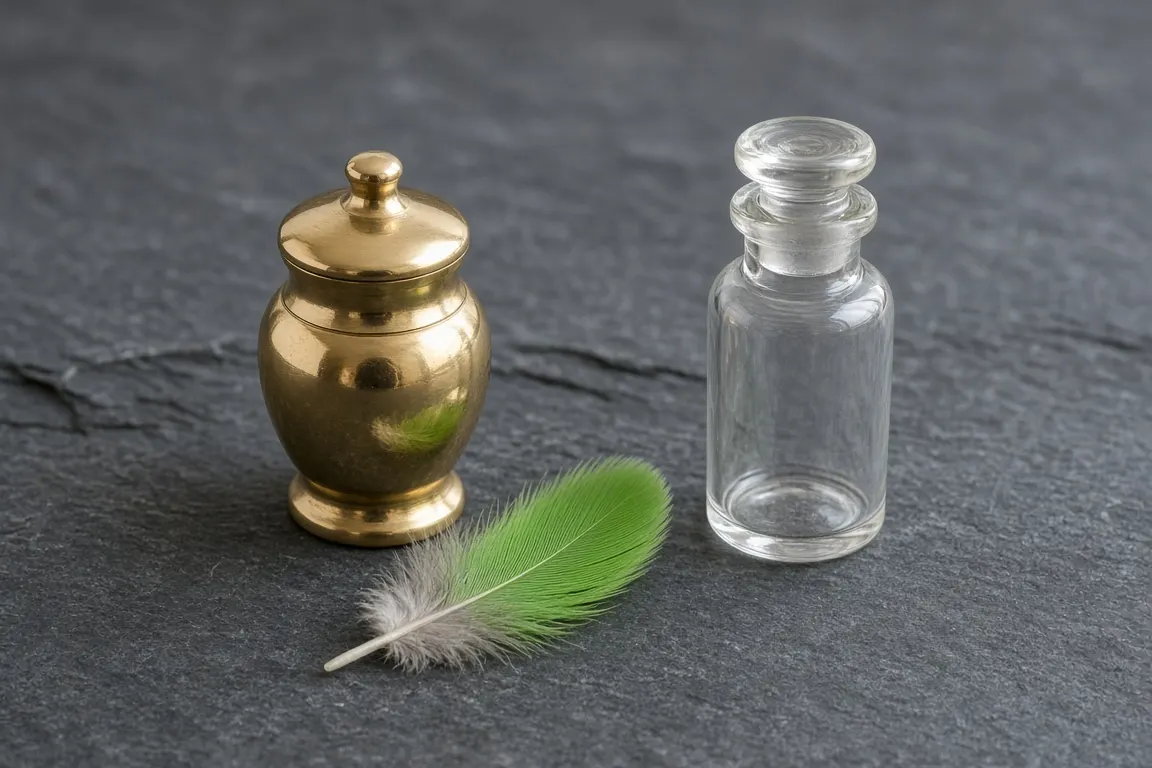
Our guide to returning micro-quantities of ash shows what the container tends to look like, so the size doesn't catch you off guard.
If a small bird returns only a pinch of ash, would you still choose private cremation?
Tap an answer to vote and see how others answered. Anonymous.
Checking what you paid for
How can you prove which cremation your bird received?
On your own, you mostly can't, which is why paperwork matters so much. By one directory's count, as of 2026 only 2 states[4], Illinois and Arizona, required crematories to hand consumers written documentation. In total, 9 states[5] have laws aimed specifically at pet crematories. Elsewhere, you're relying on each provider's own habits.
So ask for the evidence before you agree, not after the ashes arrive. These are the records and practices that turn a promise into something you can check:
- A written order that uses the word private and states that no other animal shares the chamber. The word 'individual' by itself isn't enough.
- An ID number assigned at collection that travels with your bird on a tag or card through storage, the chamber and the return.
- A certificate of cremation naming your bird, the species, the date and the cremation type.
- A heat-proof numbered disc placed in the chamber with your bird and returned with the ashes. Not every provider uses them, but many do.
- An open door. A provider confident in its process will usually let you visit, or even be present as the cremation starts.
Communal cremation leaves nothing to return, but you can still ask where the ashes are scattered and whether families may visit. Our list of questions for bird cremation providers covers the follow-ups that expose a vague answer. Training is worth asking about too: the Cremation Association of North America certifies pet crematory operators, and an operator who holds it has at least studied the procedures that keep animals separate.
Cost
How much more does private cremation cost for a bird?
The gap is real but smaller in dollars than you might fear. The UK's Competition and Markets Authority, in its appendix on cremation pricing, found communal cremation 2x to 5x cheaper[1] than individual cremation for a pet of the same weight. Comparing published prices across eight markets, our own estimate puts private at a median of ~2.0x[6] the communal price.
Because birds fall in the smallest weight band, you're typically weighing about $45 to $75 for communal against $100 to $175 for private[7], before extras. That's a difference of roughly $50 to $100. A home pickup, a weekend call or a decorative urn can easily add more than the private-or-communal choice itself.
If money is tight, communal is a perfectly loving choice. The aftercare options comparison sets cremation, burial and keepsake-only paths side by side, and our bird cremation cost guide shows how to read an itemized quote.

Free tool
Aftercare options compared
Compare private, communal and water cremation with burial on cost, timing and what comes home.
Matching the choice to the bird
Which option fits your kind of bird?
No species comes with a correct answer, but some patterns show up again and again in what keepers choose and later feel settled about.
| Bird | Likely ash | What many keepers pick | Why |
|---|---|---|---|
| Zebra finch, canary | Under a gram | Communal plus feathers, or private into a vial | So little returns that feathers or the nest often mean more |
| Budgie, lovebird, parrotlet | About 1 to 2 g | Private, if they want something to hold | Enough for a pendant, but only when a tray is used |
| Cockatiel, conure | About 3 to 6 g | Private | Fills a charm or vial; mixing would be noticeable |
| African grey, Amazon, eclectus | Roughly 12 to 22 g | Private, sometimes witnessed | Often decades together, with enough ash to share |
| Macaw, large cockatoo | About 30 to 50 g | Private | Room for a small urn plus a keepsake or two |
| Pet hen or duck | Roughly 45 to 150 g | Private, or burial at home | Similar in size to a small cat; check bird flu guidance first if several died |
Bonded pairs are their own case. When two lovebirds die within days of each other, some keepers ask for a single private cremation with the ashes deliberately combined. That's a reasonable wish, provided the order says so in writing. If a partner bird is still living, read supporting a flockmate after a loss.
Another way to keep them close
Could feathers mean more to you than ashes?
For many bird keepers, yes. A pinch of gray grit doesn't look like a cockatiel, but a lemon-yellow crest feather does. That's why some families choose communal cremation with a clear conscience: the part of their bird they want to keep never goes into the chamber.
Feathers need collecting before your bird leaves home or the clinic, and they last for decades if kept dry and out of strong sun. Pick a few from the wing or tail, or save molted ones from the cage tray. If your vet suspects an infection such as psittacosis, wait for their all-clear, and wash your hands afterwards.

Ideas for mounting them, from a simple frame to a resin block, are in our feather shadowbox guide. If you'd like help finding a provider that offers genuine private cremation for small birds, tell us where you are and we'll reply by email with options near you. The services page sets out every option side by side, and our local pages show what's typical near you.
Choosing communal isn't loving your bird less. It's deciding which part of them you want to keep.

Reader polls
What would you choose?
Vote anonymously and see how other readers answered. The results are live counts from people who visit this site, so they show real opinions, not a scientific sample.
If a small bird returns only a pinch of ash, would you still choose private cremation?
Tap an answer to vote and see how others answered. Anonymous.
If you had to decide today, which aftercare would you choose for your pet?
Tap an answer to vote and see how others answered. Anonymous.
Which memorial feels most like your pet?
Tap an answer to vote and see how others answered. Anonymous.

Questions people ask
Is partitioned cremation the same as private?
No. In a partitioned cremation your bird shares the chamber with other animals, separated by trays or dividers, and you receive what the operator recovers from your bird's section. In a private cremation your bird is alone. With a large parrot the difference may feel small, but with a finch or budgie even a little residue from another animal could be a large share of what comes back.
Do I get anything back after a communal bird cremation?
You won't receive ashes, because the remains of all the animals are combined. Some providers send a card or certificate confirming the date, and many will tell you where the ashes were scattered. If you want a keepsake, ask for a few feathers or the leg band to be set aside at collection, before the cremation happens.
How can I be sure the ashes I receive belong to my bird?
Ask for three things in writing: that the cremation is private with no other animal in the chamber, that your bird gets an ID number at collection, and that a certificate comes back with the ashes. Some crematories also return a numbered metal disc that went through the chamber with your bird. A provider who welcomes visits is usually confident in its process.
Why does private cremation for a bird cost about the same as for a cat?
Most crematories charge by weight band, and the smallest band often covers everything up to 20 or 30 pounds. The trip, paperwork, chamber heating and cleaning cost the same whether the body weighs 40 grams or 10 pounds. Some providers offer a lower small-animal rate if you ask, so it's worth checking.
Can I change from communal to private after my bird has been collected?
Often yes, if you call quickly. Communal cremations are usually batched, so there may be a day or more before the cycle runs. Phone the provider or your vet as soon as you change your mind, ask them to confirm the switch in writing, and expect to pay the difference in price.
What if the only local crematory won't do private cremation for small birds?
Some crematories only offer partitioned cycles for very small pets because a solo cycle for a 30 g bird uses the same fuel as one for a dog. Ask whether they'd run a private cycle at a higher fee, or look further afield; many providers collect from vets across a wide area. Communal cremation with kept feathers, or home burial, are also reasonable choices.
Keep reading

Bird cremation services
Every option for small birds, parrots and backyard hens.

What happens during bird cremation
Each step from collection to the ashes coming home.

How tiny ashes are returned
Vials, pouches and what a gram of ash looks like.

Bird cremation near you
Local prices, rules and collection options.
Sources and our estimates
- [1] The CMA found communal cremations are two to five times cheaper than the individual equivalent for the same pet weight. UK Competition and Markets Authority - Final report Appendix K: Cremations pricing, mark-ups and costs (24 Mar 2026), 2026.
- [2] Embrace Pet Insurance lists US communal cremation at $30-$200, partitioned at $50-$250, private at $100-$500+ and aquamation at $80-$450. Embrace Pet Insurance - Bury or Cremate Your Dog? Costs, Pros & Cons, 2025.
- [3] Embrace notes cremated remains typically weigh about 3-5% of the pet's original body weight. Embrace Pet Insurance - Bury or Cremate Your Dog? Costs, Pros & Cons, 2025.
- [4] As of April 2026 only Illinois and Arizona mandated written documentation to consumers for pet cremation. FindPetCremations - Pet Cremation Laws & Regulations by State (2026), 2026.
- [5] Nine US states have pet-crematory-specific licensing or consumer statutes: California, New York, Texas, Arizona, Virginia, Georgia, North Carolina, Maryland and Illinois. FindPetCremations - Pet Cremation Laws & Regulations by State (2026), 2026.
- [6] The median price multiple of private (ashes returned) over communal cremation across 8 markets is about 2.0x, ranging from 1.25x (Tokyo) to 5.2x (Auckland). Our estimate: median(private_price / communal_price) same weight band: US CareCredit 51-70 lb midpoints (250/75) = 3.33x; Auckland 15-25 kg (445/85) = 5.24x; Norway 1-20 kg (3790/1190) = 3.18x; Singapore 10-20 kg (480/260) = 1.85x; Ontario 25-250 lb (549/279) = 1.97x; Tokyo 20-30 kg (38500/30800) = 1.25x; France 20 kg midpoints (200/95) = 2.11x; Germany range midpoints (270/145) = 1.86x. How we calculate.
- [7] CareCredit's pet cremation guide lists US communal cremation at $45-$75 and private at $100-$175 for pets up to 30 lb. CareCredit (Synchrony) - How Much Does Pet Cremation Cost? (Sept 2023), 2023.
Find a provider that offers true private cremation
Tell us what you need and where you are. We'll reply by email with clear options and prices so you can decide in your own time.