How to make a feather shadowbox for a bird you've lost
Collect a handful of feathers (molted ones or a few taken before cremation), freeze them to kill mites, wash gently, dry on a cool setting and mount them on acid-free backing behind UV-filtering glass. Feathers from pet parrots, budgies, cockatiels and canaries are fine to keep; native wild species are a different matter.
By the Avian Cremation Services editorial team · Updated September 24, 2026 · 6 min read · Sources
- Safe cleaning steps, including psittacosis precautions
- A simple materials list and layout ideas
- What US law does and doesn't cover
The short answer
How do you turn your bird's feathers into a shadowbox?
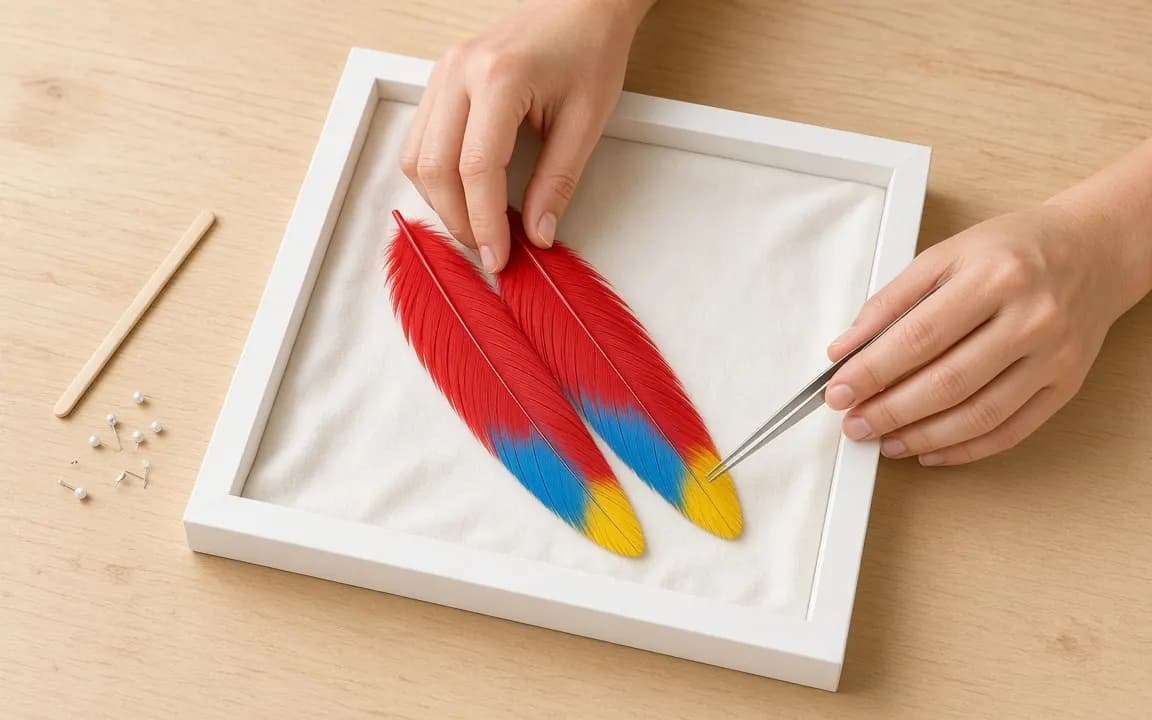
Gather five to fifteen feathers, seal them in a bag and freeze them for a few days, then wash them in lukewarm water with a drop of mild soap, dry them with a hair dryer on the cool setting, and fix them by the quill onto acid-free board inside a frame at least an inch deep. The whole job takes an afternoon of hands-on time, spread over about a week.
It's one of the few keepsakes that shows your bird's actual color. A cockatiel's crest, a budgie's barred wing, the red tail of an African grey: these are instantly recognizable to anyone who knew them. With about 6 million[1] US households keeping birds, plenty of people have a drawer of molted feathers waiting for exactly this. And unlike ash, feathers are there whether your bird weighed 15 grams or 1,000. Interest in something personal is broad: by our estimate, around 765,000 US families a year[2] are likely open to a personalized pet keepsake, and a frame of feathers is one of the few you can make at home.
Did you keep (or would you keep) any of your bird's feathers?
Tap an answer to vote and see how others answered. Anonymous.
Which feathers should you choose?
Think about what you'd want to see every day. Most shadowboxes mix a few feather types so the display has shape and texture.
- Flight feathers (long wing feathers) give structure and are the easiest to mount straight.
- Tail feathers carry some of the strongest color, like a grey's scarlet or a macaw's blue-and-gold.
- Contour feathers from the chest or back are small and soft, good for filling gaps or making a fan.
- Crest feathers from a cockatiel or cockatoo are instantly personal but delicate; handle them last.
- Down is lovely to touch but hard to wash and flattens behind glass. Keep a little in a tiny envelope instead.
Choose feathers that are whole, with the vane intact and no chewed edges. A slightly frayed feather from a favorite spot on the cage floor can still earn its place if it means something to you.
Molted feathers or feathers from the body?
If you've been saving molted feathers for years, you already have the easiest source: they fell out naturally and are fully grown. Many keepers find a shoebox of them after a loss and are glad they never threw them away.
Feathers from the body have to be collected before cremation or burial, and there's no second chance afterwards. Your avian vet can take them, or you can ask the cremation provider to set them aside and write that request into the intake notes. Our bird aftercare decision guide covers the order of steps if you haven't chosen cremation or burial yet.
- Small contour feathers come out with a gentle pull in the direction they grow.
- Large flight and tail feathers are anchored firmly; snipping close to the skin with clean scissors is kinder and easier.
- Skip any feather with a dark, waxy-looking quill. That's a growing pin feather with blood in the shaft, and it won't dry well.
How do you clean feathers safely?
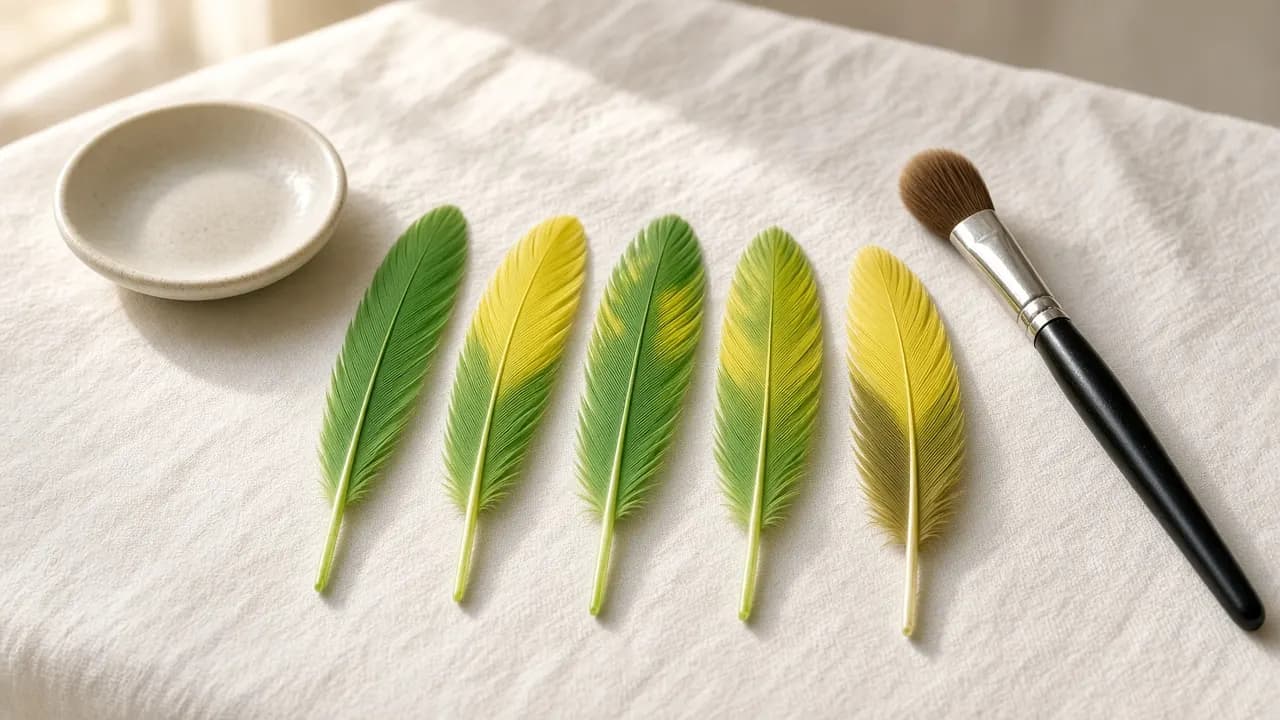
- Freeze. Seal the feathers in a zip bag, press out the air and freeze for at least 48 hours; many keepers leave them a full week. Cold kills feather mites and lice.
- Shake and brush. Hold each feather by the quill and brush loose dust off with a soft, dry paintbrush, working outdoors if you can.
- Wash. Swish each one in lukewarm water with a single drop of mild dish soap. Stroke from the quill toward the tip, never against the grain.
- Rinse. Dip in clean lukewarm water until no suds remain.
- Blot and dry. Lay flat on a paper towel, then use a hair dryer on the cool setting at arm's length. The barbs fluff up and zip back together as they dry.
- Reshape. Run the feather gently between finger and thumb from base to tip to close any splits. Let everything air-dry overnight before mounting.
Skip bleach, vinegar and hot water; they can strip color and curl the vane. Molted feathers that already look clean may only need the freeze and brush steps.
What do you need to frame them, and how should you arrange them?
- A shadowbox frame at least 1 inch deep, so feathers don't press against the glass
- UV-filtering glass or acrylic; red and yellow parrot pigments fade in sunlight
- Acid-free backing: cotton rag mat board, linen or archival foam board
- Fine stainless insect pins, or a pinhead of acid-free glue used on the quill only
- Blunt tweezers and a soft brush for placing feathers
- Optional: the leg band, a small photo, a printed name, a tiny sealed vial of ash
Lay everything out on the backing before fixing anything, and photograph a few layouts to compare. Popular arrangements include a fan of tail feathers radiating from one point, a wing shape built from flight feathers with contour feathers overlapping at the top, a color gradient from pale to bright, or a simple row under a photo. Leave breathing space around each feather; crowding hides the patterns.
Hang the finished box away from direct sun, bathrooms and kitchens. Humidity and steam can relax the vanes and invite mold.
Should you make it yourself or commission one?
Making it yourself is quiet, hands-on work that many people find helps. Frames and archival materials vary widely in price depending on size and glass, so check a local framing shop and a craft store before you buy. Some crematories also offer small add-ons such as fur clippings or paw prints at $5–$15[3], and a few will frame or envelope feathers for you; ask what they charge.
Commissioned pieces cost more but can include hand-lettering, a painted portrait of your bird, or feathers set in resin. Prices vary by maker, so get a written quote that says how many feathers they need and whether unused ones come back. If you'd like ash in the display too, a small keepsake vial or mini urn tucked into the corner usually costs about $15–$60[4]; our guide to the tiny amount of ash a bird leaves explains what will realistically fit.
To see how a shadowbox fits alongside jewelry and other items in an overall budget, try the memorial budget planner. Ash pendants alone run about $30–$300+[5], so it helps to see the whole picture.
Free tool
Memorial budget planner
Add up cremation, urn, keepsakes and a farewell so the total holds no surprises.
Is it legal to keep bird feathers in the US?
For pet birds, yes. The Migratory Bird Treaty Act protects native wild species, and generally makes it illegal to keep their feathers without a permit, even ones you find on the ground. Budgies, cockatiels, parrots, lovebirds, canaries, zebra finches and domestic chickens aren't native wild birds, so the act doesn't cover your pet's feathers.
Where people get caught out is mixing in wild feathers: a blue jay feather from the garden, a hawk feather from a walk. Leave those out. There's a health reason too. US wild bird surveillance, summarized in the USDA APHIS avian influenza report, logged 15,542 detections[6] of highly pathogenic avian influenza between late 2021 and 2025, so found feathers aren't something to bring indoors near your birds. If you kept an unusual species and aren't sure of its status, ask the US Fish and Wildlife Service before displaying it.
What else pairs well with a feather keepsake?
A shadowbox often sits beside other small memorials. Browse bird memorial ideas for voice recordings, planted gardens and photo books, or read about bird keepsakes and ash jewelry if you want something to wear. For a tiny urn that fits inside or beside the frame, see urn sizing for birds.
If your bird hasn't been cremated yet, tell us where you are and we'll look for providers who will set aside feathers and the leg band before the cremation. The services page explains how that request is usually handled. Our local pages show how pickup and prices differ by area.

Reader polls
What would you choose?
Vote anonymously and see how other readers answered. The results are live counts from people who visit this site, so they show real opinions, not a scientific sample.
Did you keep (or would you keep) any of your bird's feathers?
Tap an answer to vote and see how others answered. Anonymous.
Which memorial feels most like your pet?
Tap an answer to vote and see how others answered. Anonymous.
What personal touch matters most on a memorial?
Tap an answer to vote and see how others answered. Anonymous.

Questions people ask
How many feathers do I need for a shadowbox?
Five to fifteen is plenty for an 8 by 10 inch frame. A small bird like a budgie may only have a handful of feathers long enough to mount, so combine a few wing or tail feathers with some softer contour ones. Larger parrots give you more to work with, and you can save extras in an envelope.
Can I collect feathers after cremation?
No. Feathers burn completely in a cremation chamber, so they must be taken beforehand. If your bird is already with a provider, call as soon as you can and ask whether the cremation has happened yet. Molted feathers you saved over the years are the other source, and many keepers find more of these than they expected around the cage.
Will the colors fade over time?
They can, especially reds and yellows in direct sunlight. UV-filtering glass or acrylic slows fading a lot, and hanging the frame on a wall that doesn't catch strong afternoon light helps too. Blues and greens in parrot feathers come partly from structure rather than pigment and tend to hold up well indoors.
Do I need to clean molted feathers?
At minimum, freeze them for a couple of days to kill any mites and brush off dust. If they look dirty or were lying on the cage floor for a while, a gentle soap wash is worth it. Feathers that went straight from your bird into a clean box often need nothing more than freezing.
Can feathers be added to jewelry or resin?
Yes. Some makers set small contour feathers or snippets of a flight feather in resin pendants, rings or paperweights, sometimes alongside a pinch of ash. Ask how much material they need, whether they return unused feathers, and how long the work takes. Clean and freeze the feathers first so you're sending the maker something safe to handle.
Is it strange to keep a dead bird's feathers?
Not at all. Keeping a lock of hair or a pressed flower has a long history, and feathers are the bird-keeper's version. Many people find a frame of feathers easier to live with than an urn, because it looks like the bird they knew rather than a container.
Keep reading

Bird aftercare blog
Memorial ideas, urn sizing and keepsakes for birds of every size.

All bird guides
Decision guides for aftercare, flockmates and micro-ash return.
Bird keeper polls
See how other keepers answer questions about feathers and memorials.

Request local options
We reply by email with providers who can set feathers aside.
Sources and our estimates
- [1] About 6 million US households keep pet birds. American Pet Products Association (APPA) 2025 National Pet Owners Survey release, 2025.
- [2] Around 765,000 U.S. families a year are likely open to a personalized pet keepsake. Our estimate: 1.5M pet cremations x 51% interest in personalized memorials. How we calculate.
- [3] Memorial add-ons at A Greener Place: $15 laser-engraved paw print, $10 clay paw impression, $10 nose print, $5 fur clipping. A Greener Place Pet Aquamation – Pricing, 2026.
- [4] Keepsake or mini pet urns cost about $15–$60, versus $25–$100 for small and $40–$200 for medium urns (Memorials.com). Memorials.com – Pet Urn Cost Guide, 2025.
- [5] Cremation jewelry that holds pet ashes typically costs $30–$300+. Memorials.com – Pet Cremation Cost Guide 2026, 2026.
- [6] Wild bird surveillance recorded 15,542 H5Nx HPAI detections in at least 193 wild bird species between December 2021 and September 2025, including 8,073 in sick or dead birds. USDA APHIS CEAH - Status and Epidemiologic Analyses of HPAI-affected Poultry Flocks, September 30, 2025 Interim Report, 2025.
Ask a provider to save feathers for you
Tell us what you need and where you are. We'll reply by email with clear options and prices so you can decide in your own time.