When one bird dies and another is left behind
A surviving bird may call, fluff up or eat less for a few days after losing a cage mate, and much of that settles with steady routines and extra time with you. But because birds hide illness, any loss of appetite beyond a day, or an unexplained death in the same cage, is a reason to see an avian vet first.
By the Avian Cremation Services editorial team · Updated September 24, 2026 · 6 min read · Sources
- How to tell grief from early illness
- When to quarantine and test
- Routines and enrichment that help
The short answer
What does a surviving bird need in the first week?
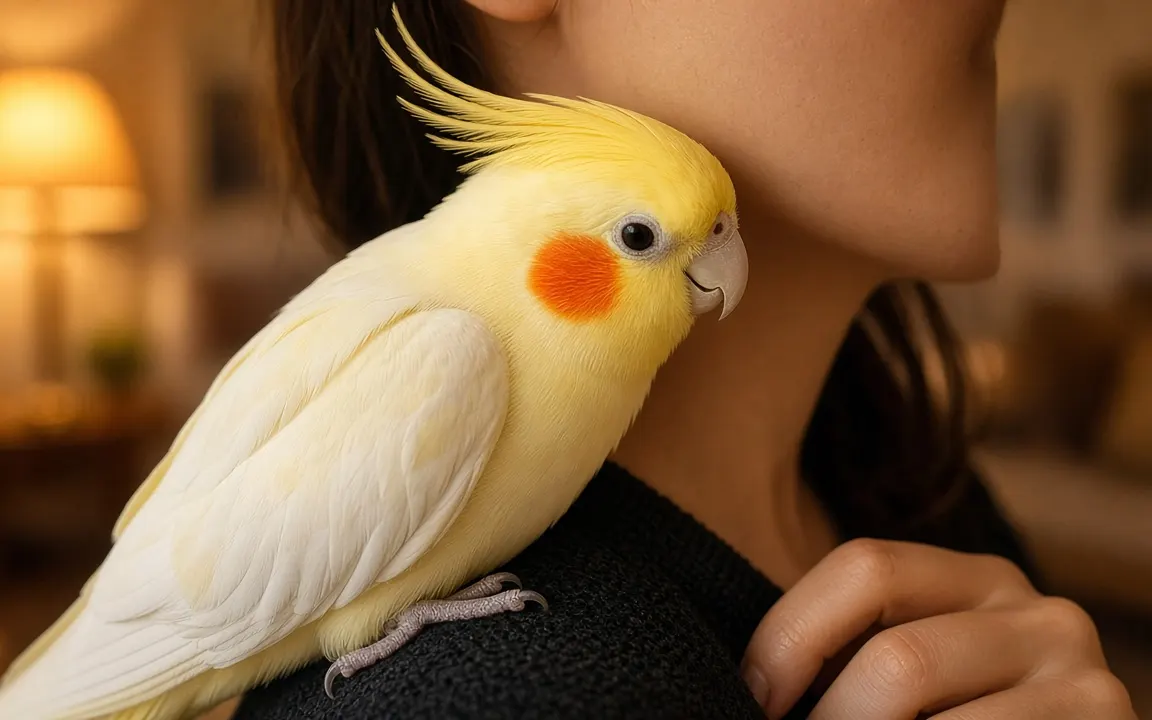
Mostly three things: a health check if the cause of death is unknown, a routine that stays as normal as possible, and more of your company. Contact calling, restlessness and a slightly quieter mood are common for a few days. Fluffed feathers, a tail that bobs with each breath, changed droppings or skipped meals point to illness, and need a vet rather than patience.
The difficulty is that birds are experts at looking fine. A budgie that seems a little flat may be sad, or may be carrying the same infection that killed their partner. So the sensible order is safety first, comfort second. Your own grief matters too, and our guide to grieving a bird is there when you're ready for it. Support can be hard to find: by our estimate, roughly 850,000 bereaved US pet households a year[1] may not find the grief support they need, so be as patient with yourself as with your bird.
Should you let the other bird see the body?
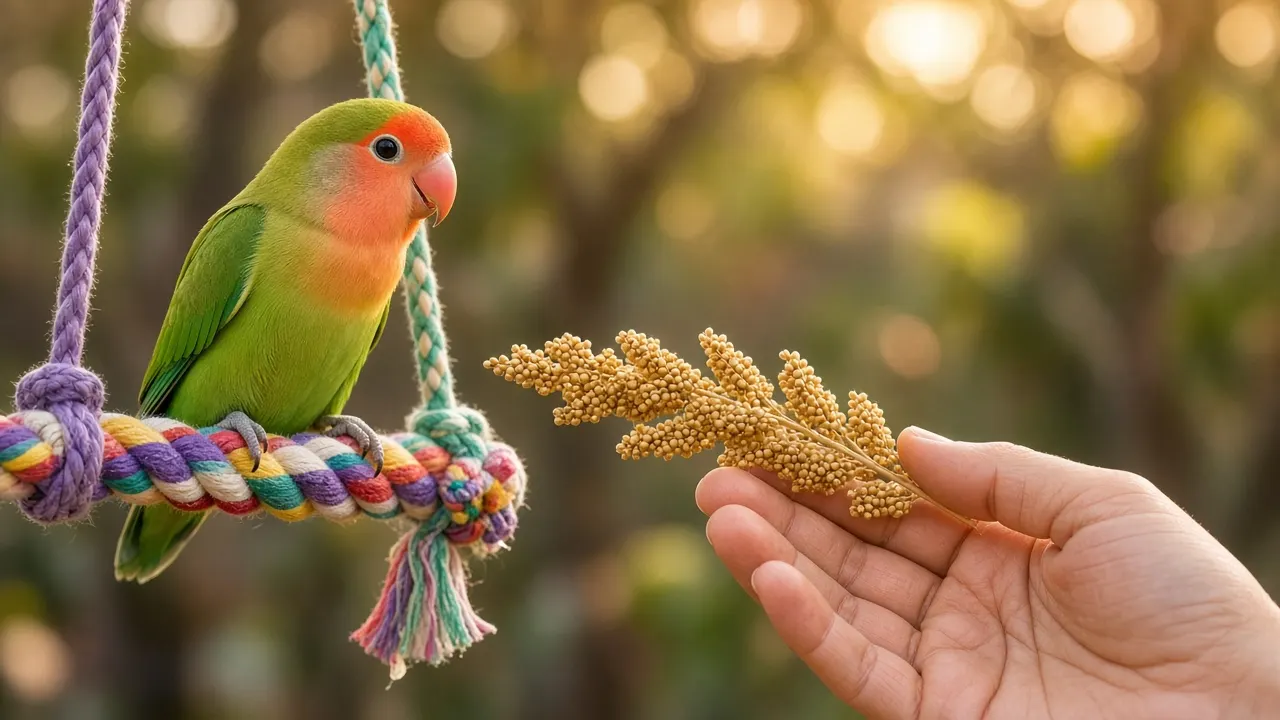
Many keepers do, and some report their bird seemed to settle afterwards, as if it understood why its partner stopped answering. There's no research that proves birds benefit, but it's a common and reasonable choice when the death was clearly not infectious, such as old age or an accident.
Keep it brief. Place your bird's body on a towel just outside the cage or on the cage floor for a few minutes, stay with them, and then remove it. Don't do this if you suspect an infection or toxin, and don't do it if you plan a necropsy and haven't refrigerated the body yet. Some birds ignore the body entirely. That isn't a sign of anything wrong.
If your bird had a companion, did you let them see the body?
Tap an answer to vote and see how others answered. Anonymous.
How can you tell grief from illness in a surviving bird?
| What you see | Often part of grief | Call your avian vet if |
|---|---|---|
| Loud or repeated contact calls | Calling for the missing bird, worst at dawn and dusk | Voice turns hoarse, clicky or wheezy |
| Eating less | Picks at food for a day, still takes treats | Skips meals for more than 24 hours or loses weight |
| Fluffed feathers | Briefly, while resting or dozing | Stays puffed up for hours, eyes half closed |
| Sitting on the cage floor | Rarely, if ever | Any time; this is an urgent sign |
| Plucking or over-preening | A little extra preening in the first days | Bare patches, broken feathers or skin damage |
| Droppings | Unchanged | Watery, discolored, or much smaller than usual |
A kitchen scale that reads in grams is the most useful tool you can own right now. Weigh your bird at the same time each morning for two weeks. A drop of about 10% is worth a call, even if everything else looks normal.
Does the survivor need a vet check or quarantine?
If you don't know why the first bird died, treat the survivor as possibly exposed. Birds that share air, perches and water share infections such as psittacosis, which the CDC describes here, avian gastric yeast and polyomavirus, and toxins such as zinc from galvanized wire or fumes from overheated non-stick cookware affect every bird in the room.
- Refrigerate the body and ask your vet about a necropsy before cremation or burial. Our bird aftercare decision guide explains how that fits with the rest.
- Book the survivor a check-up within a few days, sooner if they show any signs from the table above.
- Scrub the cage, perches and dishes with hot soapy water, then a bird-safe disinfectant, and rinse well.
- Keep other birds in the house in a separate room until the vet has an answer.
- Wear gloves while cleaning and wash your hands; some bird infections can reach people.
Which routines and enrichment help a grieving bird?
Keep the parts of the day your bird can predict: the same wake-up time, the same cover at night, food at the usual times. Move the cage only if the old spot upsets them, and don't rearrange everything at once. Many keepers leave the missing bird's favorite perch in place for a week or two rather than stripping the cage bare.
- Sit near the cage and talk, whistle or read aloud, especially at the times the pair used to call to each other.
- Offer new foraging toys: paper-wrapped treats, shreddable cardboard, a foraging tray with seeds hidden in shredded paper.
- Add a little extra out-of-cage time if your bird is hand-tame.
- A mirror can comfort some solo budgies but make others obsessive. Try it briefly and watch closely.
- Play soft background sound during the day so the room isn't suddenly silent.
A study comparing pet and human loss found that closeness to the one who died was the strongest predictor of how hard grief hits[3], and it's easy to see something similar in birds: a pair that preened each other every evening tends to struggle more than two birds who merely shared a cage. That's worth remembering for yourself as well. In a large UK survey, 72.6% of bereaved owners said they lost their daily routine[4], so keeping the bird's day steady can steady yours.
Budgies, lovebirds, cockatiels and hens: does species change things?
Budgies are intensely social flock birds, and with 28%[5] of US bird-keeping households owning one, they're the species our readers most often ask about here. A lone budgie usually does better with more human interaction and, in time, another budgie. Lovebirds in a true pair bond can take a loss hard; watch appetite and plucking especially closely. Cockatiels often call loudly for days, and many bond readily with their person if you lean in.
Backyard hens grieve less visibly but reorganize fast. When a hen at the top of the pecking order dies, expect some squabbling while a new order forms, and watch for bullying of the lowest hen. Extra feeders and waterers spread out so no one can guard them, plus a few extra hiding spots, help the flock settle. In the USDA's four-city study, 0.8%[6] of all households kept chickens, so you're far from alone in this.
Age matters too. Median captive life expectancy is about 5.5 years for budgies and 9 for cockatiels[7], per the Association of Avian Veterinarians' senior parrot guide, so a survivor may be a senior who handles stress less well. The pet age calculator shows where your bird sits in its life.

Free tool
Pet age & senior years calculator
Convert your pet's age and see when senior-care and planning conversations usually start.
Should you get a new companion, and when?
There's no set timeline. Some birds perk up quickly with a new friend; others are happier as a single bird with plenty of human company. Wait until the survivor has a clean bill of health and the cause of the first death is understood or ruled out, and wait until you actually want another bird rather than feeling you should.
When you do bring a new bird home, many avian vets suggest a separate-room quarantine of around 30 to 45 days and a health check before the two meet. Then introduce them in neutral territory or with cages side by side for a week or two. Pairing doesn't always take, so have a plan for two cages.
Meanwhile, aftercare for the bird who died still needs deciding. Our services page covers the options, feather shadowboxes are a gentle project for the weeks ahead, and our planning page helps you think ahead for the birds still with you. If you'd like local prices, tell us where you are. Our local pages cover what's available where you live.

Reader polls
What would you choose?
Vote anonymously and see how other readers answered. The results are live counts from people who visit this site, so they show real opinions, not a scientific sample.
If your bird had a companion, did you let them see the body?
Tap an answer to vote and see how others answered. Anonymous.
How long before you felt ready for another pet?
Tap an answer to vote and see how others answered. Anonymous.
What helped you most in the first weeks?
Tap an answer to vote and see how others answered. Anonymous.

Questions people ask
Do birds grieve when their cage mate dies?
Many keepers see changes that look like grief: calling for the missing bird, searching the cage, quieter moods or less interest in food. Scientists are careful about the word, but it's reasonable to treat these behaviors kindly and give your bird extra attention and stability. Just keep checking that the changes are emotional and not the early signs of illness.
How long does it take a surviving bird to adjust?
Many birds settle within one to three weeks, though tightly bonded pairs can take longer. Steady routines, more of your company and new foraging activities usually help. If your bird is still not eating properly, plucking, or sitting fluffed up after the first few days, don't wait for the adjustment period to end; see your avian vet.
Can a surviving bird catch what killed its partner?
It can, which is why an unexplained death calls for caution. Infections spread easily between birds sharing a cage, and toxins in the environment affect every bird in the room. A necropsy on the bird that died, plus a check-up for the survivor, is the surest way to know whether anything needs treating or changing at home.
Should I move the surviving bird to a new cage?
Usually not straight away. A familiar cage is reassuring, so clean and disinfect it thoroughly and put it back in its usual spot. If your vet suspects an infection, follow their advice on replacing wooden perches and rope toys, which are hard to disinfect fully.
Is it cruel to keep a budgie on its own?
Budgies are flock birds and generally do better with company, but a single budgie with lots of daily interaction, toys and attention can live well. If you're out at work all day, a second budgie is often the kinder option once the survivor is healthy and a proper quarantine has been done.
Do chickens mourn a flockmate?
Hens rarely show the calling and searching that parrots do, but a death can unsettle the whole flock and reshuffle the pecking order. Watch for bullying, crowding at feeders and a lower-ranked hen being kept away from food. Extra feeding stations and a few days of close observation usually get things back on track.
Keep reading

Bird aftercare guides
Decision guides on aftercare options, feathers and micro-ash return.

Bird aftercare blog
Grief, memorials and questions to ask providers.
What other keepers chose
Live poll results on flockmates, necropsy and new companions.

Ask for local options
We reply by email with providers who work with avian vets.
Sources and our estimates
- [1] Roughly 850,000 bereaved U.S. pet households a year may not find the grief support they need. Our estimate: 1.5M pet cremations x 56.7% couldn't find support. How we calculate.
- [2] Wild bird surveillance recorded 15,542 H5Nx HPAI detections in at least 193 wild bird species between December 2021 and September 2025, including 8,073 in sick or dead birds. USDA APHIS CEAH - Status and Epidemiologic Analyses of HPAI-affected Poultry Flocks, September 30, 2025 Interim Report, 2025.
- [3] A Death Studies paper comparing pet and human loss found closeness to the deceased was overwhelmingly the strongest predictor of grief severity, whatever the species. Europe PMC abstract — Eckerd, Barnett & Jett-Dias, 'Grief following pet and human loss: Closeness is key', Death Studies (2016), doi:10.1080/07481187.2016.1139014, 2016.
- [4] After losing a pet, 72.6% lost their daily routine or sense of purpose, 69.8% had trouble concentrating and 65.9% had sleep problems. RSPCA — Pet Loss Survey Results, 2026.
- [5] 28% of US bird-owning households have a parakeet (budgie). American Pet Products Association (APPA) 2025 National Pet Owners Survey release, 2025.
- [6] In the USDA's four-city study (Denver, Los Angeles, Miami, New York City), 0.8% of all households and 4.3% of single-family homes on an acre or more kept chickens. USDA APHIS NAHMS Poultry 2010 - Urban Chicken Ownership in Four U.S. Cities, 2010.
- [7] Median life expectancy in captivity is 5.5 years for budgerigars, 9 years for cockatiels and 9 years for African grey parrots, versus captive longevity records of 18, 35 and 48 years. Association of Avian Veterinarians - Care for Senior Parrots (client handout), Table 1.
Get aftercare options while you care for your flock
Tell us what you need and where you are. We'll reply by email with clear options and prices so you can decide in your own time.